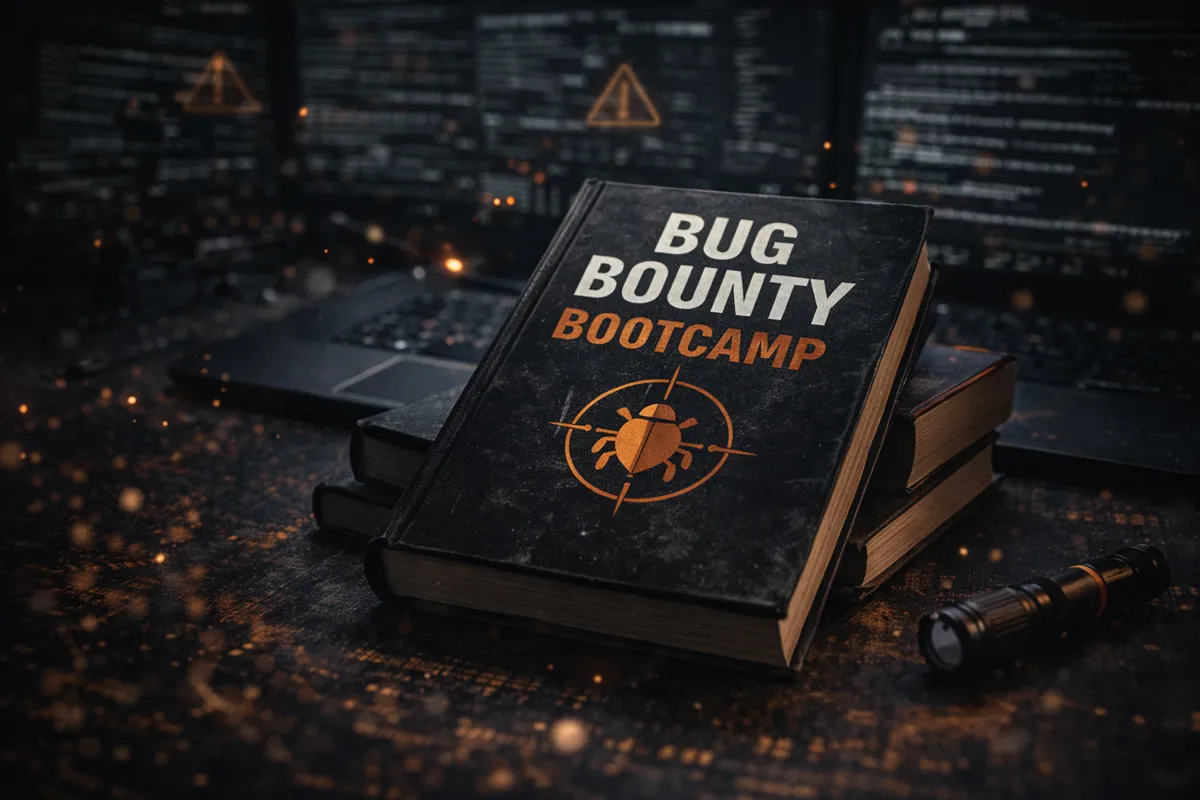
Book Review - Bug Bounty Bootcamp
Posted on January 21, 2026 by Jack Mason
This was my first proper web app “holiday read,” and I actually tackled it while I was away in Thailand. Looking back, the timing was perfect. I had just taken my first attempt at the Burp Suite Certified Practitioner (BSCP) exam, and to be honest, I was severely under-prepared for it. I needed something that would fill in the gaps and give me a different perspective on the common vulnerabilities I was seeing in the labs, and Vickie Li’s Bug Bounty Bootcamp turned out to be exactly that. It is a fresh look at the world of web security that is just as applicable to professional penetration testers as it is to bug hunters.
The book jumps straight into the deep end of web application testing. While the primary focus is technically on the bug bounty side of things, the content is entirely relevant to standard web application penetration testing. It provides a solid methodology for mapping out a website, performing detailed reconnaissance, and exploiting common issues. In fact, I have found myself coming back to this book several times since that trip. Whenever I find a specific issue and want a quick refresher on the best way to exploit it, this is usually the first place I look.
Most of my training up until this point had come from the PortSwigger labs. While I have completed nearly all of them and eventually passed the BSCP exam, I realised those labs tend to focus heavily on the application layer. They sometimes ignore the real-world mistakes that developers make outside of the code itself, such as environment issues and hosting blunders.
This is where this book really shines, particularly in the reconnaissance section. It covers areas that traditional labs often miss, such as GitHub reconnaissance. The author talks about using tools like Trufflehog to hunt for secrets and keys that developers have accidentally pushed to public repositories, which is a massive area of risk. It also goes into detail on inspecting hosting configurations on platforms like AWS to find misconfigured buckets or services. The book doesn’t just tell you what to look for: it explains how to automate the process using publicly available tools, which is a massive time-saver during the initial stages of a test.
One of my favourite things about the book is how it breaks down every single vulnerability into a repeatable, structured template. Instead of just giving you a payload, it explains the mechanisms behind how the vulnerability actually works and what the developer should be doing to fix it. It then walks you through the process of hunting for the issue in the wild, what to do when you encounter basic filters, and how to escalate a “low” impact bug into a “critical” one. Having this easy-to-follow methodology for testing every exploit has been a great addition to my own testing workflow.
Ultimately, this book provides a fantastic introduction to web testing and has pretty much all the information you need to become a great tester. It doesn’t cover every single niche aspect of web security, but it is an excellent starting point for anyone looking to get into the industry or for experienced testers looking to better themselves. While The Web Application Hacker’s Handbook is the classic “behemoth” that everyone talks about, this is the modern manual that I would actually recommend to someone starting out today. It teaches you that success in web testing isn’t about knowing a “magic” payload: it is about having a consistent process for mapping, hunting, and escalating.